How to reduce energy consumption in internal logistics?
According to analyses by Atres Intralogistics, implementing a milk-run system allows for a fleet reduction of 30–50%, which directly reduces a plant’s energy consumption.
Nowadays, energy efficiency is not only an element of a CSR strategy but, above all, a key factor influencing a company’s profitability. Although companies typically focus on optimizing production lines, significant savings can be found in in-plant logistics.
We present 7 key strategies that, thanks to intelligent flow control, significantly reduce production energy demand.
Reducing energy costs doesn’t always require investing in new production machinery. A change in the transportation model can be a breakthrough: moving away from distributed forklifts and toward an integrated logistics loop. This is an effective way to reduce the number of engines in motion and significantly reduce operating costs. Paweł Czynszak, Commercial Director, Atres Intralogistics
1. Milkrun System and Consolidation of Transport Processes
Transporting individual loads with forklifts generates the highest energy losses. The use of logistics trains (Milkrun/Mizumashi) enables the service of multiple locations within a single cycle. According to research by Atres Intralogistics, replacing forklifts with logistics trains results in a five-fold reduction in internal transport costs over a five-year period, which directly reduces the electricity consumption needed to power the fleet.
2. Strategic Planning of the Hall Layout
In the spirit of the Lean philosophy, every unnecessary transport is waste (Muda). Every additional distance traveled by a vehicle generates unnecessary energy costs. Properly positioning transshipment points, shortening travel routes, yields measurable results. Even a 10% reduction in distance for a fleet of 20 units translates into thousands of kilowatt-hours saved annually.
3. Synchronizing production timing with logistics (Just-in-Sequence)
Energy is wasted every time a pallet is unnecessarily moved. Milkrun systems enforce a regular delivery rhythm, which stabilizes energy consumption and eliminates peak shaving—sudden peaks in demand, which are the most expensive in energy billing.
4. Energy recovery in internal transport
Modern electric tug fleets are “power plants on wheels.” Thanks to energy recovery systems during braking (energy recovery), it is possible to recover 5% to 15% of energy. In high-traffic processes, this directly extends the work cycle on a single charge and reduces network load. Atres intralogistics tugger trains work perfectly in combination with electric tugs.
5. Cell Modernization: Li-Ion Instead of Lead-Acid
If you must use forklifts, the decision to switch to lithium-ion batteries is pure energy mathematics. Li-Ion batteries have an efficiency of approximately 95%, while traditional lead-acid batteries only reach 70%. Furthermore, the ability to charge (opportunity charging) allows for better management of the entire plant’s energy profile.
6. Digital Twins
Intuitive route planning often leads to errors. Simulating flows in a digital environment allows us to detect bottlenecks before they actually occur. This helps us avoid situations where machines are idling, waiting for delayed transport, which is one of the most hidden forms of energy waste.
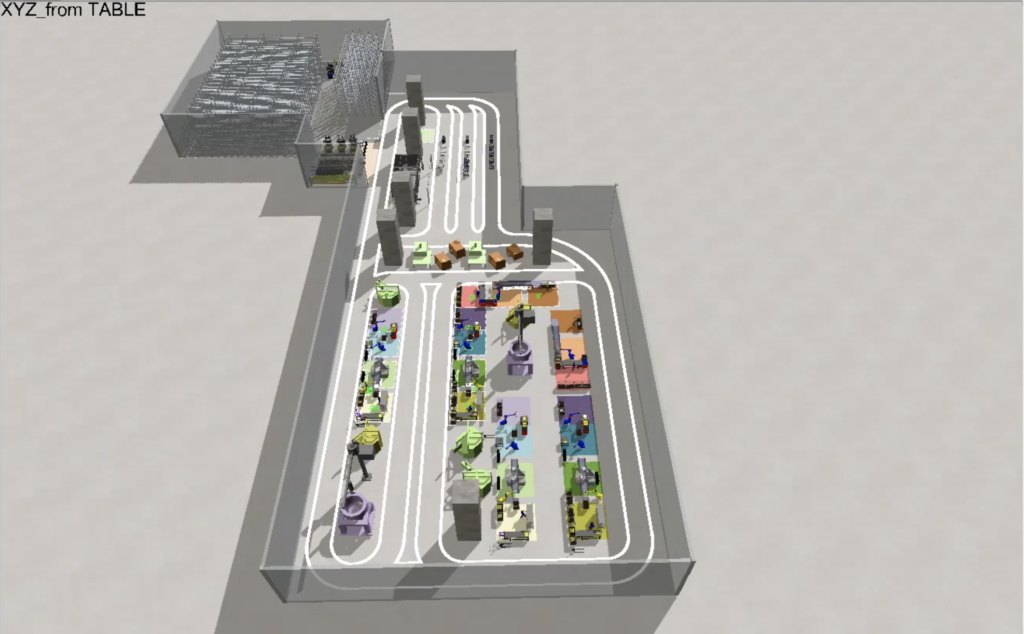
A view of the production floor prepared in LogABS®, a tool for creating digital twins of factories
7. Green Logistics Culture and KPIs
According to Fraunhofer Institute analyses, plants that monitor energy in real time and link it to specific logistics processes can identify up to 20% of hidden energy losses.
In summary, optimizing intralogistics through the implementation of the Milkrun (Mizumashi) system is an effective way to reduce energy consumption and operating costs. We encourage you to conduct a detailed analysis of your current transport processes to identify waste and improve the energy efficiency of your entire plant.