
Internal Transport Safety – How an Intralogistics Project Eliminates the Risk of Accidents on the Production Floor
Why is internal transport one of the greatest sources of hazards in production?
Safety on the production floor is not the result of a larger number of procedures, but is primarily related to traffic predictability. And this begins at the intralogistics design stage.
The numbers leave no doubt. According to preliminary data from the National Labor Inspectorate in Poland for 2024, industrial processing is the industry with the highest number of injuries in workplace accidents – 633 people in investigated accidents, more than in any other sector. The previous year, there were 696, and in 2021, as many as 806. The trend is decreasing, but the pace of improvement is insufficient given the scale of the risk.
OHS procedures in internal transport have reached a ceiling. The problem lies higher up.
In the debate on safety in intralogistics, internal transport is consistently underestimated as a risk category. The Polish National Labor Inspectorate’s (PIP) data for 2024 is clear: industrial processing accounts for the highest absolute number of injuries in workplace accidents among all sectors – 633 people in accidents investigated by inspectors, with an accident rate of 7.56 per 1,000 employees. For comparison, the information and communications sector records a rate of 0.70.
A typical organizational response to such data is to intensify administrative activities: another round of occupational health and safety training for internal transport, additional signage, tightened procedures, and internal audits. This approach has a built-in effectiveness ceiling because it addresses symptoms, not systemic causes. The cause is aptly captured by Systems Safety Theory: accidents are the result not of individual human errors, but of interactions between humans, machines, and work environments designed to tolerate or even generate hazardous conditions. In production intralogistics, this environment is the architecture of the internal transport system.
Three Mechanisms Through which Internal Transport Generates Risks That Cannot Be Controlled Procedurally
Reducing occupational accidents related to internal transport requires first understanding the structural origins of this risk. There are three main mechanisms:
- Stochasticity of Traffic. Transport performed on demand by a fleet of operators with individual driving habits creates traffic that is statistically unpredictable for other participants in the hall. The employee at the workstation has no cognitive model to anticipate when and where a vehicle will arrive. This requires constant vigilance – a mechanism that is unreliable, especially during long-term, routine tasks.
- Degradation of the Field of View with Loads. CIOP (Central Institute for Labor and Labor Protection) research documents that over 80% of forklift accidents are related to insufficient visibility of the surroundings on the operator’s side. A front-end truck operator transporting a load at driving level loses visibility ahead – this is a geometric property of the vehicle, independent of the operator’s qualifications and experience.
- Reversing as a Permanent Part of the Work Cycle Reversing, when retrieving pallets from nests, maneuvering in narrow aisles, or leaving delivery points, combines limited rearward visibility with movement in a direction unanticipated by pedestrians. Procedurally eliminating this maneuver is practically impossible: the operator must reverse because the space of the hall and the geometry of the task require it.
The combination of these three features creates a system in which safety is only maintained when traffic volume is low and time pressure is absent. This is a condition that is frequently not met in a production environment, especially during shift changes or line start-ups.
| Truck Model Characteristics | Risk Mechanism | Effectiveness of Administrative Measures |
|---|---|---|
| Aperiodic movement (on demand) | Unpredictable for pedestrians | Low – requires constant vigilance |
| Degradation of the field of view with the load | Collisions when driving with the mast raised | Low – vehicle geometric characteristic |
| Reversing as part of the normal cycle | Pedestrian exposure to the vehicle without the operator’s visibility | Very low – requires route reconstruction |
| Fleet dispersion | Multiplication of collision points | Low – reduces, not eliminates |
Route Design Determines the Safety of Internal Transport More Than Anything Else Later
Design decisions at the transport system concept stage have a greater impact on the risk profile than all subsequent administrative measures. In the ISO 45001 hierarchy of protective measures, the highest level is hazard elimination – not marking it or warning it, but eliminating it from the system structure.
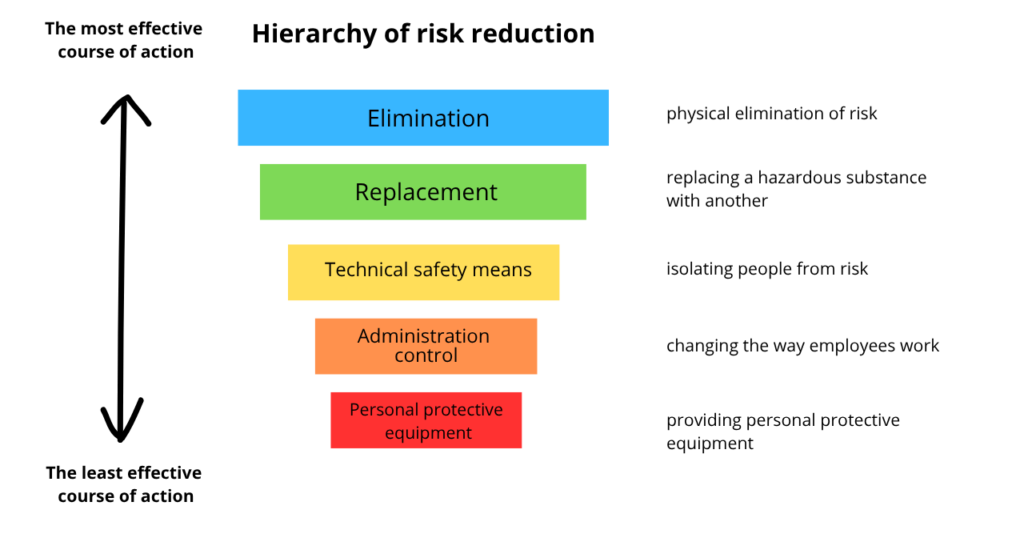
Risk mitigation hierarchy according to ISO 45001. Source: CIOP
An intersection with a pedestrian walkway is a design error, not a point requiring marking.
Every intersection of an internal transport route with a pedestrian walkway is a risk point with a non-zero probability of an incident. The first design response should be a revision of the route topology to eliminate this intersection – not a warning sign. In practice, production halls have limited topography, and not every intersection can be eliminated. Each non-eliminable intersection must have its risk level identified and an active measure assigned: advance signals, presence sensors, or a physical vehicle speed limiter.
Simulation tools such as LogABS® developed by Atres enable 3D modeling of route topology before physical marking on the ground. Iterative optimization of the loop layout to minimize collision points in a virtual environment is methodically more effective and less expensive than corrections after the system has been launched.
Minimum Widths of Transport Routes – Regulations and Practice
The Regulation of the Minister of Labor and Social Policy of September 26, 1997, specifies the minimum widths of transport routes: vehicle width + 90 cm for a one-way road, 2 x vehicle width + 180 cm for a two-way road. For Milk Run trains, whose overall width and length exceed a standard forklift, meeting these parameters in the existing hall layout often requires revision.
A more restrictive design parameter is the minimum turning radius of the train at full length. Underestimating this parameter at the design stage is one of the most common causes of forced back-ups during operation. The route design must take into account the maximum train length and the minimum radius at that length, with a safety margin resulting from variability in wagon load.
Wagons designed by Atres® can be equipped with the Flextrack® driving system, which allows the train to operate with a tighter turning radius than other systems, directly expanding the range of halls where eliminating back-ups is feasible without remodeling.
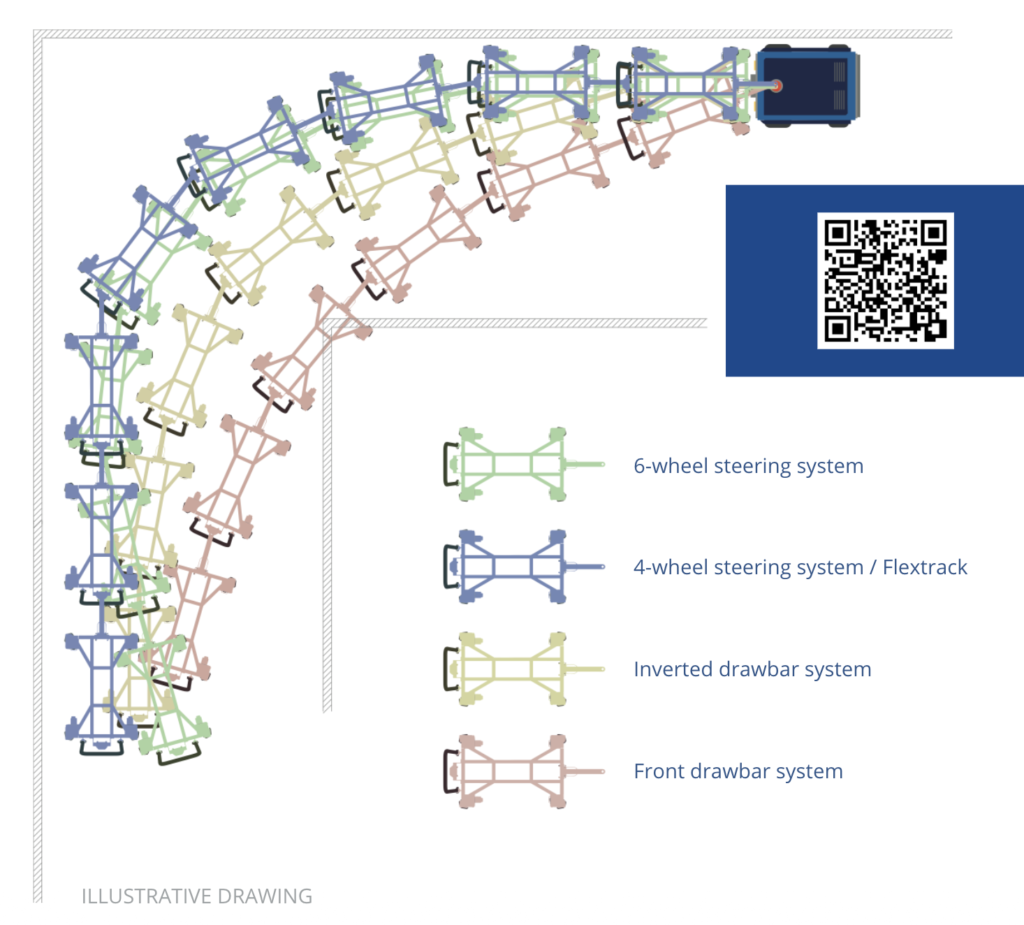
Turning radius of logistics trains depending on the running gear used. Illustrative drawing based on Atres Intralogistisc’s own studies.
Transport Station: Where the Design Must Resolve Three Conflicts at Once
The point where a vehicle stops, containers are exchanged, and the route resumes is one of the more complex points in the system: the vehicle is parked, the operator is performing the exchange, and the line worker has access to the area. The design must resolve these conflicts spatially—not procedurally: a designated area for the vehicle to stop on the floor, a separate operator access path, and a container exchange area that does not cross the pedestrian walkway.
Production Hall Signage as the Foundation for Internal Transport Safety
Production Hall Signage
Production Hall signage is not a documentary or aesthetic element. It is an information layer of the system that allows every user to clearly orient themselves without having to stop: where I am, what’s coming, and whether I can pass.
EU-OSHA estimates that over 20% of industrial accidents are related to organizational errors and a lack of clear signage. Research by the Fraunhofer Institute (2023) indicates that implementing visual management systems in production halls reduces the number of operational errors by 30–40%.
Color Coding and System Consistency
The PN-91/B-01005 standard defines the colors of lines on industrial floors: yellow for transport zones and warning boundaries, and white for pedestrian routes. In intralogistics systems with dedicated logistics train routes, it is advisable to expand the dictionary to include a separate color identifying the Milk Run route – allowing employees to immediately locate the train’s activity zone without reading signs.
The key to effectiveness is absolute consistency of production hall signage throughout the entire facility. A single section of the route marked inconsistently with the standard – even in a newly opened section – disrupts the employee’s cognitive model and creates risk precisely where the system should be most legible.
Active Signaling Instead of Passive Signage at Intersections
At intersections that cannot be eliminated from the route design, passive road markings – such as a STOP line or a vehicle pictogram – have demonstrably low effectiveness as a sole protective measure. An effective solution is active traffic lights, triggered by an approaching vehicle, which warn pedestrians well in advance to safely stop. This is complemented by panoramic mirrors that eliminate blind spots around corners and physical speed bumps that enforce speed reductions before intersections.
Component Supermarkets and Storage Zone Addressing
A component supermarket must be organized as an address system with granularity that allows for the unambiguous assignment of each storage location. An operator cannot search for material while standing in an active zone – stopping outside the schedule and searching for material means that the deterministic system switches to stochastic mode, with all its consequences.
Safety by Design: Milk Run’s position in the ISO 45001 hierarchy of protective measures
ISO 45001:2018 formalizes the hierarchy of protective measures. From the highest level: hazard elimination, substitution, collective technical measures, administrative measures, and personal protective equipment.
Most organizations place safety efforts at levels four and five: procedures, training, job instructions, and reflective vests. These measures are necessary, but methodologically secondary – and their effectiveness is a derivative of the quality of the higher levels, not a substitute for them.
A properly designed Milk Run system operates at levels one and two:
- Elimination: A one-way loop eliminates backing as a work event; route topology optimization eliminates intersections; e-kanban eliminates ad hoc off-schedule movement.
- Substitution: The Milk Run system replaces the forklift fleet as a cyclical line supply – replacing a high-risk means of transport with a structurally lower-risk means of transport.
Active layers (scanners, signaling) and administrative layers (schedule, signage) complement the higher levels, but their effectiveness presupposes correct system design. Technology applied to a poorly designed route topology addresses the symptom, not the cause.
Checklist – 12 Questions for Assessing Internal Transport Safety in the Hall
The questions below allow you to assess whether the internal transport system is operating in a risk management mode (administrative measures) or in a risk elimination mode (system design). A “no” answer to questions 1–5 indicates a structural deficiency that no administrative action will permanently eliminate.
- Are transport routes and pedestrian walkways physically separated or clearly marked on the floor?
- Do vehicle operators know when and where other vehicles are passing (schedule, timetable)?
- Is the number of vehicles on the hall at one time minimized and controlled?
- Is vehicle reversing limited by the route design, not just by instructions?
- Are intersections of transport routes with pedestrian walkways marked and/or equipped with traffic signals?
- Are road markings up-to-date, legible, and in good condition (no worn lines)?
- Are stations and stopping points clearly designated and visible from a distance of at least 10 meters?
- Have production workers been trained in traffic management – not just vehicle operators?
- Are near-miss incidents recorded and analyzed?
- Is the risk assessment for internal transport up-to-date and covers all modes of transport used?
- Does the production line’s power supply system eliminate the need for additional, unscheduled forklift trips?
- Was the intralogistics system designed with safety as a design criterion, rather than as a requirement added after the fact?
Summary
The risk profile of internal transport in a production facility is the result of design decisions made before the system was launched, not the quality of procedures implemented after the fact. The cart model creates risks in the form of geometrically restricted visibility and the need to back up as part of the normal cycle. Administrative measures can mitigate this risk; eliminating it requires architectural intervention.
A properly designed Milk Run system operates at the elimination and substitution level of the ISO 45001 hierarchy. Deterministic movement trajectories, unidirectional loops that eliminate backing up, a reduction in the number of simultaneous vehicles, and optional integration with an e-kanban system that eliminates ad hoc traffic create an environment in which predictability is a feature of the system, not the result of operator discipline.
This is the fundamental difference between safety management and safety design. And it is precisely this difference that determines the number of accidents that are possible.
FAQ
How is occupational health and safety in internal transport regulated in Polish law?
The basis is the Labor Code and the Regulation of the Minister of Labor and Social Policy of September 26, 1997, on general occupational health and safety regulations, and for motor-driven forklifts, the Regulation of the Minister of Economy of May 10, 2002. The employer is responsible for organizing safe internal transport: route marking, risk assessment, training, and traffic supervision.
How does production hall signage impact transport safety?
Consistent horizontal and vertical signage creates an information layer that allows everyone in the hall to immediately and clearly orient themselves. EU-OSHA estimates that over 20% of industrial accidents are related to a lack of clear signage. However, floor lines, transport zone markings, and active signals at intersections only act as a supplement to proper route design—not as a substitute for it.
How to conduct an occupational risk assessment for internal transport?
The assessment should include: identifying all means of transport and their routes, mapping collision points with pedestrian routes, analyzing maneuvers requiring backing up, assessing visibility at key points along the route, and verifying compliance of road widths with the regulations. Updating is required for any layout change, introducing a new means of transport, or after an accident or near-miss.
How can safety in intralogistics be quickly improved without changing the system?
The most effective short-term measures include: physical separation of pedestrian and transport traffic, implementing a route schedule even for the existing fleet, supplementing road markings in high-traffic areas, and implementing near-miss registration. These measures reduce risk but do not eliminate its structural sources – backing up, stochasticity, and the number of concurrent vehicles.
Does the implementation of the Milk Run system require a production stop?
No. The implementation is being carried out in stages – loop by loop. During the transition phase, both systems operate in parallel, with clearly defined operational areas and an updated risk assessment for each loop launched.
Does ISO 45001 cover internal transport on the production floor? Yes. ISO 45001 applies to all occupational hazard areas – including internal transport, machine operation, and production hall traffic management. A safety management system compliant with ISO 45001 requires documentation of hazard identification, risk assessment, and implemented control measures for each of these areas.