

Mizumashi trolleys – what are they and how do they optimize internal logistics in a company?
What are Mizumashi trolleys and how do they work?
Mizumashi trolleys are an internal transport system used in production logistics, derived from the lean manufacturing philosophy. Their main goal is to ensure a continuous, repeatable, and optimized flow of materials between the warehouse and the production line.
The Mizumashi system operates on the principle of regular routes (the so-called “milkman’s loop“), in which a single transport unit:
- delivers components to workstations,
- collects finished products or empty packages,
- eliminates unnecessary movements and downtime.
👉 This enables real optimization of internal transport and cost reductions compared to forklifts by up to several dozen percent.
Why is Mizumashi a key element of internal logistics?
In modern production plants, traditional transport (e.g., forklifts) often generates:
- operational chaos,
- empty runs,
- excess inventory at workstations.
The Mizumashi system solves these problems through:
- supply standardization,
- predictable material flow,
- integration with kanban and just-in-time systems.
Mizumashi System Structure and Components
A Mizumashi-based internal logistics system consists of four key elements:
- Part Plan (PFEP). Determines which materials are needed, in what quantities, and when.
- Parts Supermarket. A material buffer that feeds production according to demand.
- Mizumashi Routes. Fixed, cyclical transport routes (milk runs) that ensure continuous supply.
- Kanban Pull System. Controls material flow based on actual consumption.
Where are Mizumashi Logistics Trolleys Used?
Transport trolleys are most often used in factories equipped with assembly lines to deliver production components to specific workstations in the right quantities and at the right time. Mizumashi trolleys are primarily used in internal logistics, serving areas between warehouses and production, as well as between successive production processes. They are particularly useful where processes are repetitive and the factory layout allows for the establishment of a continuous supply loop.
Mizumashi logistics trolleys are best suited for environments where:
- processes are repetitive,
- the plant layout allows for the establishment of fixed routes,
- production operates in a lean or just-in-time model.
Common applications:
- transport between warehouses and production,
- assembly line support,
- material flow between production processes.
Benefits and Advantages of Mizusumashi Trolleys
Operational Efficiency
The primary advantage of Mizusumashi trolleys over forklifts is their ability to deliver significantly more production components in a single run and simultaneously retrieve finished products from workstations. Experts in implementing Mizusumashi systems emphasize that their implementation primarily reduces empty runs by up to several dozen percent compared to forklift transport.
Mizumashi trolleys:
- transport more materials in a single run,
- reduce empty runs,
- stabilize logistics processes.
Safety and Organization
Besides increased operational efficiency, the use of Mizusumashi trolleys significantly increases safety on the production floor. This is due to the expanded field of view of the Mizusumashi trolley driver compared to their forklift counterpart.
| Comparison Criterion | Forklift | Mizusumashi Trolley |
| Forward Visibility | Severely limited by the mast, carriage, and the transported load. | Full and direct – there are no structural elements or load in front of the operator. |
| Side Visibility | Limited by the cab design (protective pillars). | Wide (panoramic) – the low truck body allows for a full view of the halls. |
| Blind Spots | Numerous and extensive, especially directly in front of the truck and behind the load. | Minimized – the design promotes almost constant observation of the surroundings. |
| Direction of Travel | Often requires reverse driving with large loads (unnatural body position). | Always drive forward in the direction of travel, which is natural and safer. |
| Reaction to Hazards | Delayed due to the need to lean out or rely on mirrors. | Immediate thanks to the ability to see obstacles well in advance. |
| Load Height | The load often obscures the operator’s horizon. | Loads on the carriages are below the driver’s line of sight. |
Unlike forklifts:
- the operator has full visibility,
- driving always moves forward,
- the number of blind spots is minimal.
Economic Benefits
Mizusumashi trolleys enable efficient operation of personnel and equipment used for internal transport operations and reduce the costs of rented or purchased forklifts by using fewer trolleys.
Additionally, implementing Mizusumashi trolleys minimizes material inventories on production lines, reducing storage costs and the risk of raw material expiration.
The Mizumashi system:
- reduces equipment requirements,
- reduces labor costs,
- reduces inventory and warehouse space.
Disadvantages and Limitations of the System
Technical Limitations
The primary limitation of Mizumashi transport units is the single-level transport of goods. Mizumashi trolleys are not designed for multi-level racking or truck loading. Forklifts or lift trucks are much more suitable for these applications.
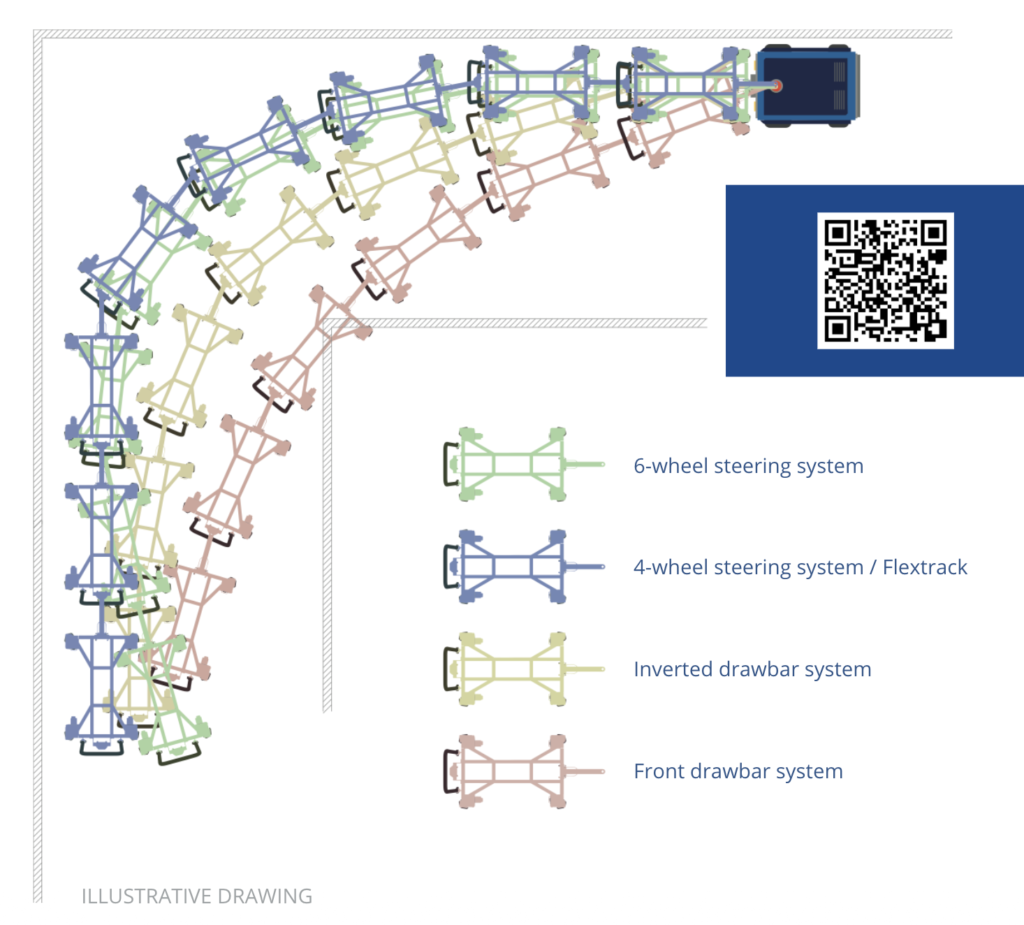
Furthermore, when designing transport routes for Mizusumashi trolleys, it is important to consider the deviations in the path of the first and last trolleys in the train. This is particularly evident in the track simulations conducted by Atres Intralogistics using various traction systems.
Organizational Challenges
Introducing Mizumashi trains requires thorough preparation in the form of a careful analysis of production needs, planning of transport routes, and adaptation of the plant’s infrastructure. When simulating Mizumashi operations in a new factory (or in the event of changes to the existing transport system), simulation tools based on lean methodology, such as LogABS, can be helpful.
Summary – is Mizumashi worth it?
Mizumashi trains are one of the most effective tools for optimizing internal logistics in production plants.
Key benefits:
- reduced transport costs,
- improved safety,
- eliminated downtime,
- standardized processes.
👉 If your company is developing towards lean manufacturing, Mizumashi is a solution worth considering.


